


Publications
Draft GDP requirements for veterinary medicinal products
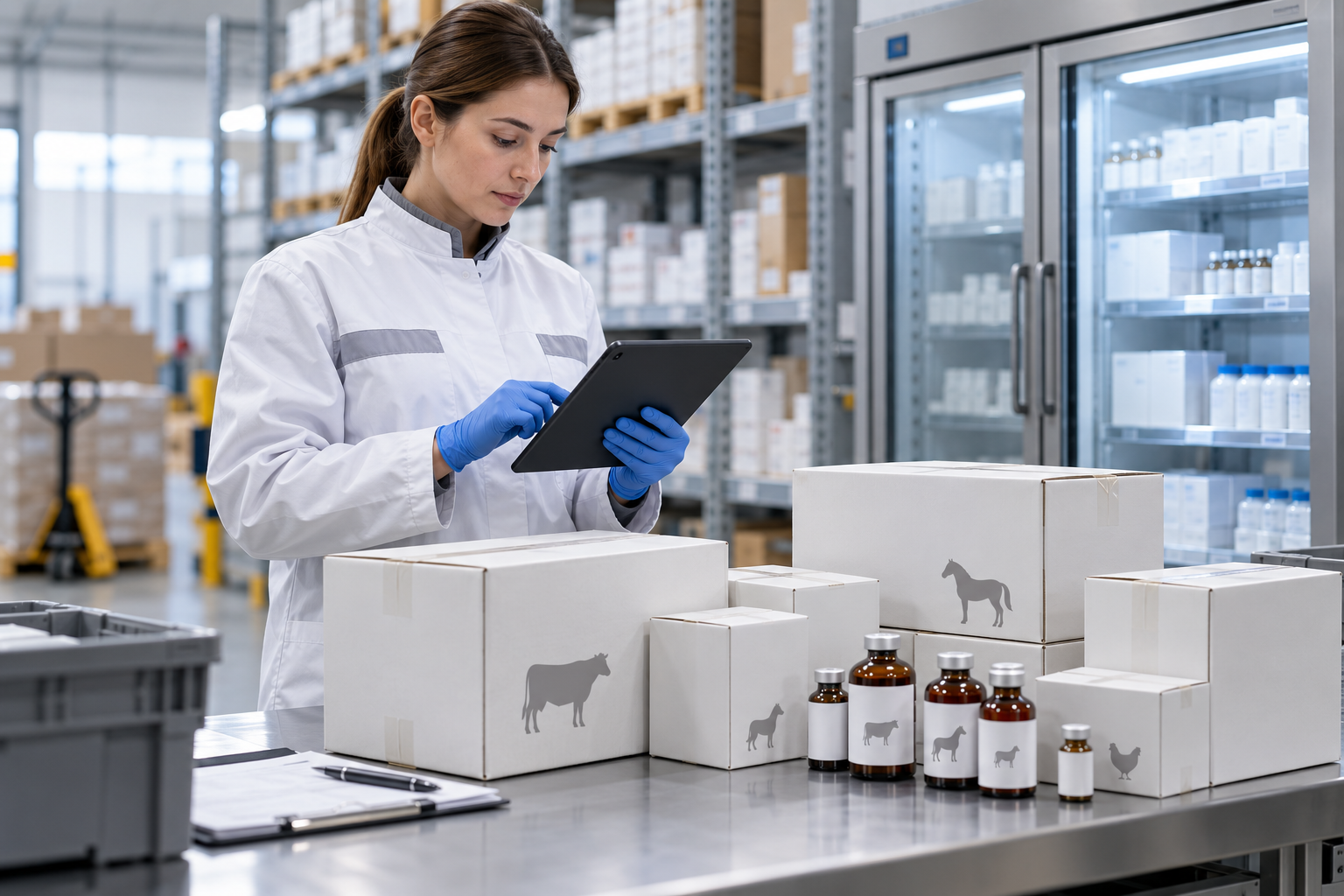
The Ministry of Agrarian Policy and Food of Ukraine has prepared draft requirements for Good Distribution Practice (GDP) for veterinary medicinal products. The document sets out rules for preserving the quality and integrity of these products within the legal supply chain during wholesale distribution, including storage and transport.
According to the explanatory note, the draft aims to align Ukrainian GDP requirements with European Union legislation. The proposed provisions cover the quality system, personnel, premises and equipment, documentation, operations, complaints, returns, falsified products and recalls, outsourced activities, self-inspections and transport.
Basis for the draft and scope of application
The explanatory note identifies Article 68(2) of the Law of Ukraine “On Veterinary Medicine and Animal Welfare”, commitments under the Association Agreement and the National Programme for the Adaptation of Ukrainian Legislation to EU Law as the basis for the draft. It names Regulation (EU) 2019/6 on veterinary medicinal products and Commission Implementing Regulation (EU) 2021/1248 on measures for good distribution practice for veterinary medicinal products as the principal EU acts in this area.
The draft would make the requirements mandatory for market operators licensed for the manufacture and import of veterinary medicinal products that carry out wholesale distribution, as well as operators licensed for wholesale distribution. Its scope also includes operators registered or operating under special customs arrangements, such as free zones or customs warehouses.
The quality system and responsible persons
Operators would have to establish and maintain a documented quality system reflecting the scale, structure and complexity of their activities. It would define responsibilities, processes and quality risk management principles. The draft provides for a quality manual or equivalent documentation, change control, the documentation and investigation of deviations, corrective and preventive actions, and periodic management review of the system.
Persons responsible for wholesale distribution would have to ensure GDP compliance, implementation of the quality system, training, approval of suppliers and customers, complaint handling, recalls and self-inspections. They could delegate tasks, but not their responsibilities. Personnel would receive initial and continuing training, with training records and assessments of effectiveness. Specialised training is envisaged for handling products that require stricter conditions.
Premises and control of storage conditions
Premises would have to provide the required storage conditions, stock security, access control, cleanliness and pest protection. Expired, recalled and rejected veterinary medicinal products would have to be physically segregated from other stock. Where the draft permits electronic segregation to replace physical segregation, the system would have to provide an equivalent level of security and be appropriately validated.
Control of storage conditions would cover temperature, light, humidity and cleanliness. The draft provides for initial temperature mapping of storage areas under representative conditions, placement of monitoring devices according to the results, and repeat mapping based on risk assessment or following significant changes. For small premises maintained at room temperature, it specifies an approach based on assessment of potential risks. Equipment used to control storage conditions would be calibrated at defined intervals.
Documentation and computerised systems
Procedures and records would have to be understandable to personnel, accessible and up to date. Records would be made as operations are performed. Changes to documents would be signed and dated, while allowing the original information to remain legible. Documents would be retained for at least five years, or longer where required by applicable legislation.
Before a computerised system enters use, validation or verification studies would have to demonstrate its ability to produce accurate, consistent and reproducible results. The draft provides for restricted access to data entry and modification, protection against accidental or unauthorised changes, backups and recovery procedures. The extent of qualification of key equipment and validation of key processes would be determined through a documented risk assessment.
Suppliers and product operations
Suppliers would have to be checked and approved before products are procured, including checks of GDP compliance and the relevant licence. The draft identifies the State Service of Ukraine on Food Safety and Consumer Protection or the State Register of Veterinary Medicinal Product Market Operators as information sources. It also provides for initial and, as appropriate, periodic customer checks to establish their entitlement to receive these products.
Receipt checks would establish whether a delivery matches the order, comes from an approved supplier and has sustained no damage. Products requiring special storage conditions or security measures would receive priority. Stock rotation would follow the first expiry, first out principle, with exceptions documented. Deliveries would be accompanied by a paper or electronic document, and records would enable the location of a product to be established. Separate rules cover disposal or destruction of unsuitable products and export, including measures to prevent products intended exclusively for export from entering the Ukrainian market, subject to the exception provided by the Law.
Complaints and returns
The draft distinguishes complaints about product quality from complaints about wholesale distribution. The manufacturer or marketing authorisation holder would have to be informed without delay of a possible quality defect. Distribution complaints would be investigated to establish their source or cause.
Return to saleable stock would be permitted only if all the conditions in the draft are met. These include original unopened and undamaged secondary packaging, an unexpired shelf life, no recall, evidence of compliance with handling conditions and assessment by a competent person. The draft excludes products returned by an animal owner to a retail operator, as well as recovered stolen products, from such return to stock. Products requiring special temperature conditions would need documented evidence that those conditions were maintained throughout the specified delivery and return stages. Any deviation would require a risk assessment demonstrating product integrity.
Falsified products and recalls
If products are identified as falsified or suspected of falsification, the draft provides for their distribution to cease without delay and for immediate notification of the State Service of Ukraine on Food Safety and Consumer Protection. The incident would be documented and investigated. Falsified products would have to be physically segregated in a dedicated area and appropriately labelled.
For recalls, the draft requires traceability of products received and distributed, and the ability to initiate recall measures immediately at any time. It provides for notification of customers and the State Service of Ukraine on Food Safety and Consumer Protection. For exported products, recipients or competent authorities in third countries would be notified. A final report would reconcile the quantities of recalled products supplied and returned.
Outsourced activities and self inspections
The contract giver would remain responsible for outsourced activities. The draft provides for an assessment of the contractor’s competence, contractual requirements, an audit before activities begin and subsequent monitoring. Further subcontracting would require prior assessment and approval by the contract giver, and an audit of the third party by the contract giver or contractor.
A self-inspection programme would cover all aspects of GDP. Competent personnel would conduct detailed and impartial inspections and document the results. Independent external audits would not replace self-inspections. Where deficiencies are identified, their causes would have to be established, corrective and preventive actions documented, and their effectiveness reviewed.
Transport and temperature control
Operators supplying veterinary medicinal products would be responsible for protection against damage, deterioration and theft, and for keeping temperatures within acceptable limits during transport. Conditions would have to follow the instructions of the manufacturer or marketing authorisation holder, or the information on the secondary packaging. The draft provides for delivery route risk assessments and a procedure for investigating temperature excursions.
For temperature-sensitive products, the draft provides for equipment subject to qualification, such as thermal packaging or temperature-controlled containers or vehicles, unless product stability has been demonstrated under other transport conditions. It also sets requirements for seasonal controls, the use of cool-packs and personnel training. Information confirming compliance with temperature conditions would have to be provided on a justified customer request and, in all cases, following an incident.
Expected outcomes and status of the draft
The explanatory note identifies uniform and clear rules for quality system management, traceability, improved quality of veterinary medicinal products and stronger state control over their circulation as expected outcomes. According to the note, implementation of the order would not require additional funding from the state or local budgets.
The Ukrainian Veterinary Alliance is analysing the published draft documents and their potential impact on veterinary medicinal product market operators.
