


Ukrainian Veterinary Alliance at EuroTier 2026: healthy animals, workable rules and veterinary training
- Details
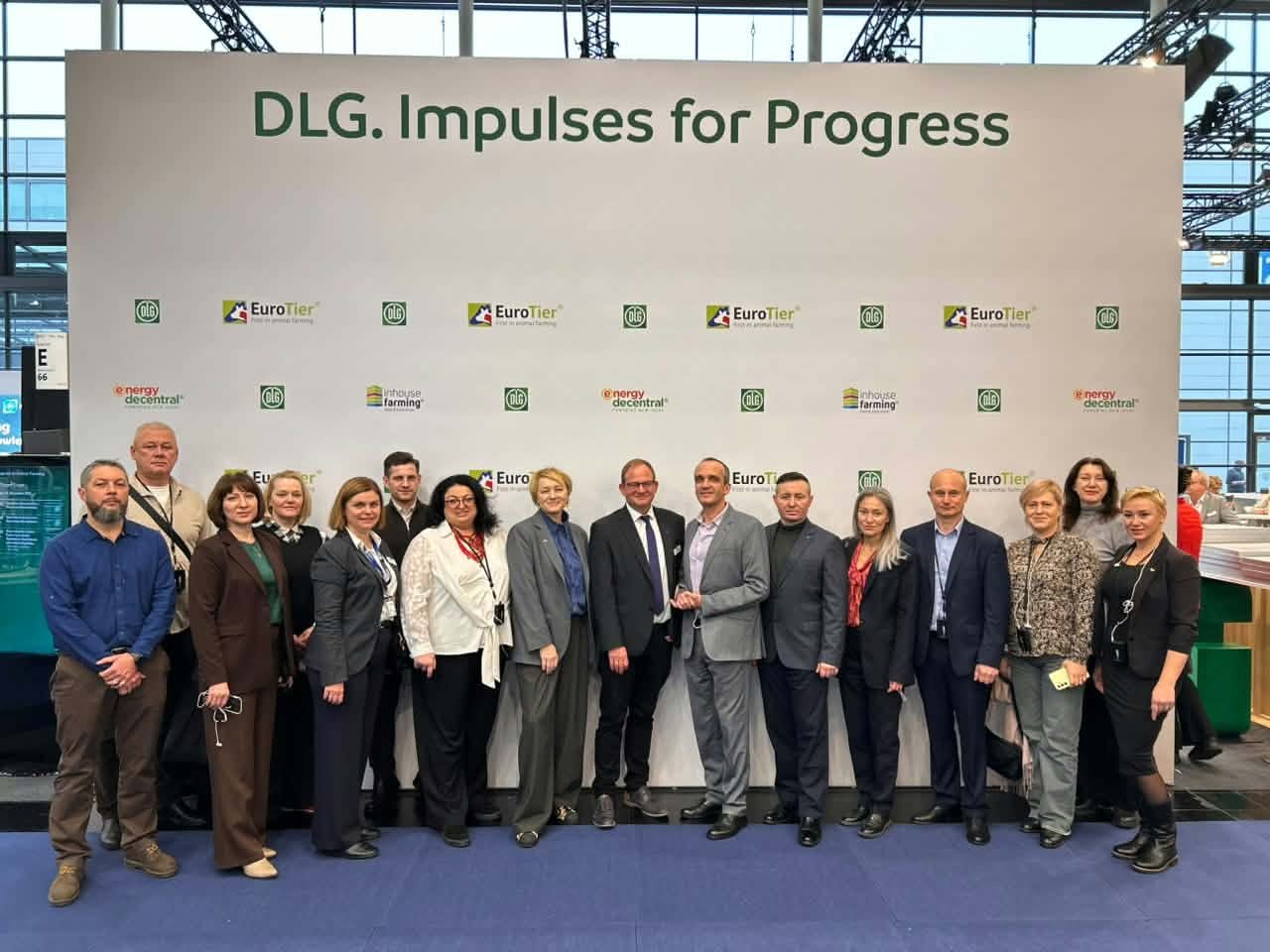
On 11 November 2026, Hanna Skyba, Executive Director of the Ukrainian Veterinary Alliance, spoke on a panel at the expert forum “Ukrainian Livestock on the Way to the EU: Standards, Investment and Competitiveness” at EuroTier in Hanover. Her key message: Ukrainian livestock farming’s path to the EU starts on the farm – with healthy animals, prevention and a qualified veterinarian. For the sector, this means European standards must not only be written into law but also made workable in practice. This is exactly what the Alliance works on together with public authorities, business and veterinarians.
The forum was organised by the German-Ukrainian Agricultural Policy Dialogue (APD Ukraine) and the German Agricultural Society DLG on the DLG Expert Stage. It was part of an APD study tour, “Transformation of Ukraine’s Livestock Sector in the Process of EU Integration – Innovation, Animal Welfare and Competitiveness”, which brought together representatives of the Ministry of Agrarian Policy and Food, the State Service of Ukraine on Food Safety and Consumer Protection, the relevant committee of the Verkhovna Rada, industry associations, universities and agricultural research institutions.
The panel “Priorities, Financing and Concrete Opportunities for Cooperation” addressed three questions: which modernisation steps should come first, how to finance higher standards, and what forms of cooperation are possible between Ukrainian and German companies. Alongside Hanna Skyba, the panel included representatives of the Ministry of Agrarian Policy and Food, the German Livestock Association (ADT) and the sheep and goat sector. The discussion was moderated by Dr Olga Trofimtseva, Head of APD Ukraine.
Where modernisation should start
Answering the first question, Hanna Skyba named three steps that bring Ukrainian farms closest to European standards.
- Biosecurity and prevention instead of treatment. African swine fever, foot-and-mouth disease and avian influenza know no borders, so protecting Ukrainian farms also protects European ones. Vaccination, disinfection and farm access control remain the cheapest way to prevent losses.
- Responsible use of antibiotics. The EU already requires exporting countries to guarantee that animals were not raised with antibiotics as growth promoters. For access to the EU market, the shift from treatment to prevention is therefore a condition, not a wish.
- A qualified veterinarian on every farm. Standards are implemented by people, not documents. Because of the war, there are fewer veterinarians in rural areas, while new European rules require new knowledge from them: prescribing veterinary medicines, keeping records of their use, safety monitoring and antibiotic control.
Making higher standards economically viable
On financing, Hanna Skyba stressed that the best returns come not from the most expensive investments but from those that prevent losses.
- Prevention is cheaper than an outbreak. Vaccination or a biosecurity system costs far less than losing a herd or an export market.
- Training is the cheapest investment with the fastest return. The best equipment will not deliver results without a specialist who knows how to manage herd health.
- Predictable rules are an investment too. Ukraine has already adopted new veterinary legislation based on the European model. It covers animal health and welfare, disease control, veterinary practice and the circulation of veterinary medicines. What matters now is realistic implementation: clear transition periods, well-prepared public authorities and laboratories, and no requirements that only add costs without improving safety. In the end, the farmer pays for every unnecessary procedure.
- Reliable supply of veterinary medicines is a matter of food security. Almost 80% of animal vaccines in Ukraine are imported, mostly from the EU. Amid russia’s armed aggression against Ukraine, reliable supply is critical.
- Donor and bank programmes should be directed specifically at biosecurity, vaccination and veterinary training.
How the Alliance supports the implementation of EU standards
Hanna Skyba also explained how the Ukrainian Veterinary Alliance helps ensure that European requirements work in practice, not only on paper.
- Dialogue with public authorities. The Alliance is in constant communication with public authorities on aligning Ukraine’s veterinary legislation with EU requirements.
- Engagement with business. The Alliance gathers the experience of manufacturers, distributors and veterinarians and brings it to the authorities, so that laws and secondary legislation are ones that can be complied with in practice.
- Training for veterinarians. The Alliance regularly runs training events and explains newly adopted legislation, so that professionals understand the new requirements in advance and can meet them.
The Ukrainian Veterinary Alliance thanks the German-Ukrainian Agricultural Policy Dialogue and personally its Head, Dr Olga Trofimtseva, for their support, the invitation to the study tour and the opportunity to present the sector’s position to Ukrainian and German partners, and DLG for organising the forum. The Alliance remains ready to share the sector’s experience and support the state in making European standards a working reality in Ukrainian livestock farming.
Read also
 9 November 2026
Draft Law No. 15058-d adopted at first reading: what it means for the veterinary medicinal products market
 4 November 2026
The European Commission's 2026 Report: what it says about animal welfare and veterinary medicinal products in Ukraine
 13 September 2026
Veterinary Pharmacovigilance: How the EU System Works