


Publications
The European Commission's 2026 Report: what it says about animal welfare and veterinary medicinal products in Ukraine
- Details
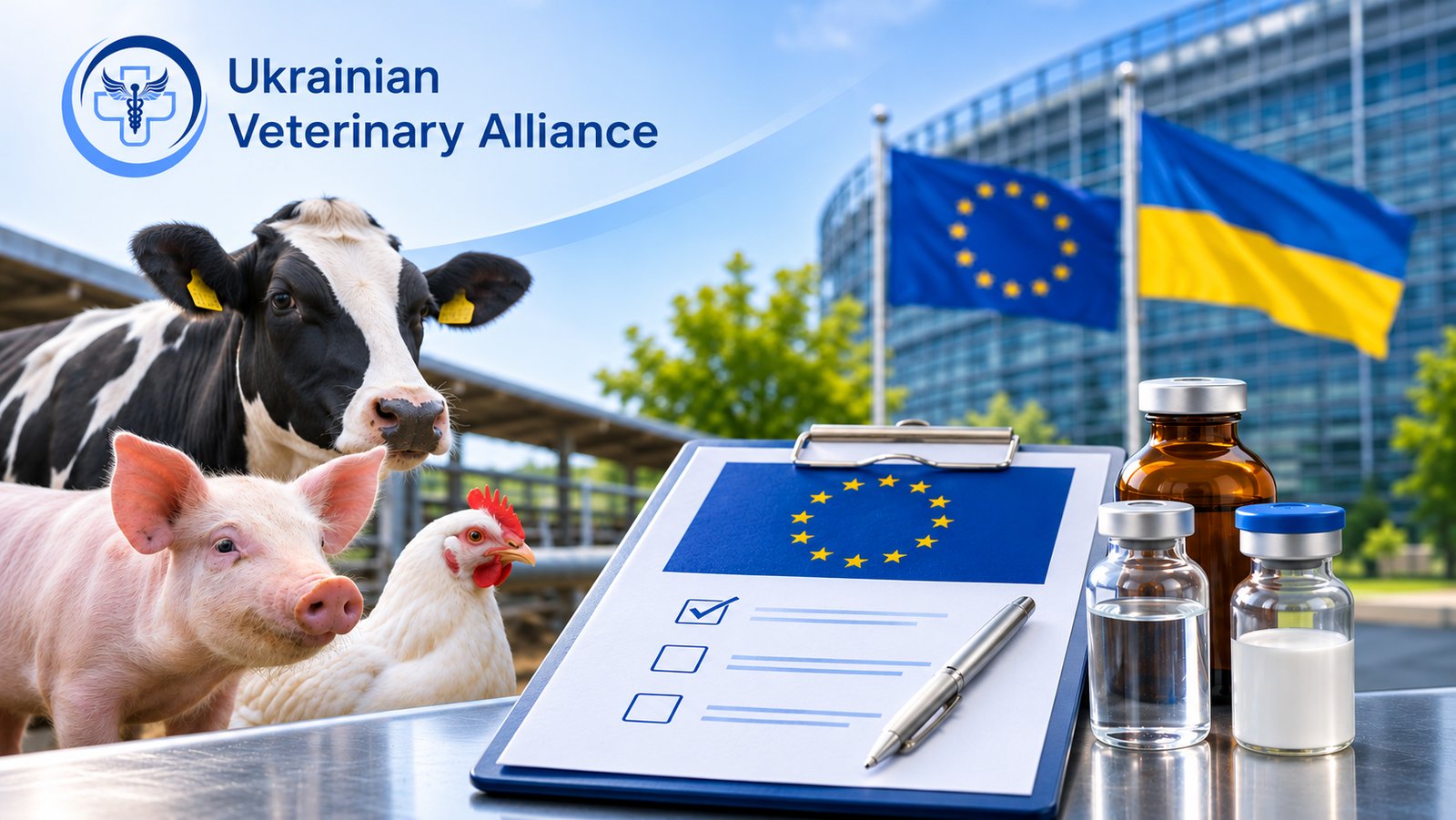
In its Ukraine 2026 Report, the European Commission noted progress on veterinary medicinal products: the adoption of the amended Law on Veterinary Medicine and Animal Welfare. At the same time, the Commission points out that implementation remains at an early stage, most secondary legislation is still lacking, and the GMP transition period under the law as it stands ends on 1 July 2027. For the sector, this means that the coming year must become the year of secondary legislation and institutional capacity.
The report was published on 4 November 2026 as part of the Enlargement Package and covers the period from 1 September 2025 to 1 September 2026. The Commission assesses the veterinary field in two chapters: Chapter 12 (animal health and welfare, feed, official controls) and Chapter 28 (veterinary medicinal products). Below is what has changed over the year and what the Commission expects from Ukraine in 2027.
The 2025 assessment: the starting point
A year ago, the Commission rated Ukraine under Chapter 12 as “moderately prepared” with “some progress”. That progress came not from veterinary matters but from the framework law on plant health and the expansion of the TRACES system.
On animal welfare, the 2025 report was brief: Ukraine was only partially aligned with the EU acquis. The Commission called for completing legislative alignment, substantially strengthening resources and administrative capacity, and setting clear timelines for implementation.
On veterinary medicinal products, the assessment was more reserved: the Commission recorded no progress on alignment with the EU acquis and noted only that a new draft law on veterinary medicines was being prepared. That draft became Law No. 4718-IX, which amended Law No. 1206-IX “On Veterinary Medicine and Animal Welfare”.
The 2026 assessment: what changed in a year
The Chapter 12 rating is unchanged: “moderately prepared”, “some progress”. But for the first time, the Commission links that progress to the veterinary field: the amended law entered into force in March 2026, and TRACES issued over 38,000 certificates for 32 commodities during the year.
Animal welfare: legislative progress, implementation just starting
Legislation on the welfare of animals on farm and at the time of slaughter has entered into force, and legislation on welfare during transport is being prepared. The animal welfare roadmap for 2025–2027 is being implemented, and the relevant measures are included in the livestock development programme until 2033. A telling example is Order No. 224: since January 2026, barren cages for laying hens have been banned. At the same time, the Commission notes that implementation remains at an early stage: official controls are not fully operational, and training systems, certificates of competence, registries, checklists and standard operating procedures are not yet in place.
Animal health: alignment continues
Legislation is still not aligned with the EU acquis, registers and IT systems are not yet fully operational, and vaccination (above all against rabies) needs to be stepped up. The Commission also noted that the amended law includes rules on medicated feed.
Veterinary medicinal products: progress acknowledged, with reservations
Where last year the Commission recorded no progress, this year it counts the adoption of the law among the achievements of the period. At the same time, the report contains three reservations worth noting:
- the law has not yet been sent to the Commission for assessment of its alignment with the EU acquis;
- implementation is at an early stage, and most secondary legislation is lacking;
- among the missing acts are the good manufacturing practice (GMP) requirements, while the transition period under the current wording of the law ends on 1 July 2027.
Draft Law No. 15058-d, which would move these deadlines to 2028, is not mentioned in the report: the Commission assesses the law as it currently stands.
The Commission's recommendations for 2027
The Commission notes that last year's recommendations were partially implemented and therefore remain valid. For 2027, it sets the following priorities for the veterinary field.
Under Chapter 12:
- advance alignment with the EU acquis in line with the obligations under the revised DCFTA, in particular in the fields of animal welfare, animal feed, plant protection products, GMOs and official controls;
- strengthen administrative capacity for official controls: laboratories, infrastructure and databases;
- continue the reform of the food safety bodies, in particular by strengthening the capacity of the State Service of Ukraine on Food Safety and Consumer Protection for risk assessment, risk communication and risk-based planning.
Under Chapter 28:
- adopt the secondary legislation necessary to complete alignment with the EU acquis on medicinal products for human and veterinary use.
The Commission also repeats the cross-cutting issues for Chapter 12: limited institutional capacity (laboratories, qualified personnel, functioning state registers) and the limitations on official controls under martial law. Ukraine is advised to resume risk-based controls systematically.
The Alliance's position: priorities for 2027
The Commission's assessment matches what the Ukrainian Veterinary Alliance has been pointing to throughout the year: once the law is adopted, the main task becomes building the infrastructure to implement it. In our view, 2027 should focus on five areas.
- Realistic deadlines. In July 2026, the Alliance and the Ministry of Agrarian Policy and Food agreed to postpone the deadlines: 1 July 2028 for GMP, GDP and batch testing requirements, and 1 September 2028 for import and distribution licensing. These dates are set out in Draft Law No. 15058-d, which has been recommended for adoption. Its timely adoption will avoid the risk of disruptions in the supply of vaccines and medicines in 2027.
- Core secondary legislation. Above all, the GMP and GDP requirements for veterinary medicinal products and the procedure for keeping registration dossiers up to date. The Alliance supported the draft order on GMP requirements and submitted its proposals, and Alliance members took part in the consultation on the draft GDP requirements. The Alliance has prepared a draft procedure on registration dossiers together with its lawyers and will shortly present it for discussion with stakeholders.
- Capacity for controls. Ukraine currently has 7 accredited laboratories for batch testing, the GMP inspection system is still being set up, and the registers and IT systems mentioned in the report are not yet in operation. We believe it is important that new obligations for business take effect in step with the state's readiness to administer them.
- Assessment of the law by the European Commission. Sending the amended law to the Commission opens a direct professional dialogue with DG SANTE on the provisions that need clarification. The Alliance is ready to share its work and its contacts with European industry associations with the Ministry.
- Tools for animal welfare. This means training, certificates of competence and checklists for inspectors. For manufacturers and distributors, it means that requirements for products and documentation for farms and slaughterhouses will change in the coming years, and the Alliance will involve its members in the consultation on these acts at the draft stage.
The Commission's next report will be published in autumn 2027. The Ukrainian Veterinary Alliance will continue to work with the Ministry of Agrarian Policy and Food, the State Service of Ukraine on Food Safety and Consumer Protection, the EU Delegation to Ukraine and European industry associations so that the next report records not only adopted acts, but a working system. We are open to cooperation with all market participants in this work.
Sources
Read also
 06 October 2026
Draft GDP requirements for veterinary medicinal products
 05 October 2026
Ukraine Prepares Rules for the Use of a Special Logo for Online Sales of Veterinary Medicinal Products
 21 September 2026
5-7-9% Recovery Loans for Businesses Affected by russian Attacks: Terms for the Veterinary Sector
